Govern
Run manifest
Every run freezes a snapshot of exactly what it was authorized to do the instant it was created, not whatever your config says right now. That snapshot is stored on the run record (metadata.run_manifest) and, when the run is actually dispatched to a runner, copied onto the queued job too. Admin can pull it up for any run, forever.
What it is
At createRunCtx: the single function every run creation path (REST, streaming, cron, A2A delegation)
goes through, the plane resolves the agent, the runner it will dispatch to, its declared tool allowlist and
connector needs, whether connector policy is fail-closed, and who asked for the run. That resolved set of facts
is written once, as run.metadata.run_manifest, and copied verbatim onto the queued job the runner
receives. Neither copy changes after that point, even if you edit langgraph.json, rotate a grant,
or flip policy on a minute later.
Why it is here
"What was this agent even allowed to do when it ran?" is a question every audit, incident review, and support ticket eventually asks. Live config answers "what's allowed right now", which is the wrong answer once anything has changed since. A frozen per-run record is the only honest answer to a question about the past.
What's in it (schema v1)
{
  "schema_version": 1,
  "captured_at": "2026-09-05T02:58:06Z",
  "tenant_id": "acme",
  "agent_id": "sales-bot",
  "agent_version": 3,
  "runner_kind": "python-langgraph",
  "connector_needs": ["salesforce"],
  "allowed_tools": ["lookup_account"],
  "policy_fail_closed": true,
  "principal": { "identity": "alice", "permissions": ["runs:create"] },
  "parent_run_id": null,
  "depth": 0
}
agent_version: the registry version dispatched, so "which build of the agent actually ran" survives a later redeploy.allowed_tools: absent means no in-graph tool allowlist was configured (unrestricted); present, including an empty list, means the runner was told to refuse every tool call not on it.policy_fail_closed: whether the connectorpolicysection was configured for this dispatch (true= a policy engine was active; it does not mean every call was denied). Specific allow/deny/pending decisions are still Grants & HITL and PDP / Cedar: see Audit for the decision log.principal: omitted entirely when no auth provider is configured (open local/dev mode), not a blank record.
In the product
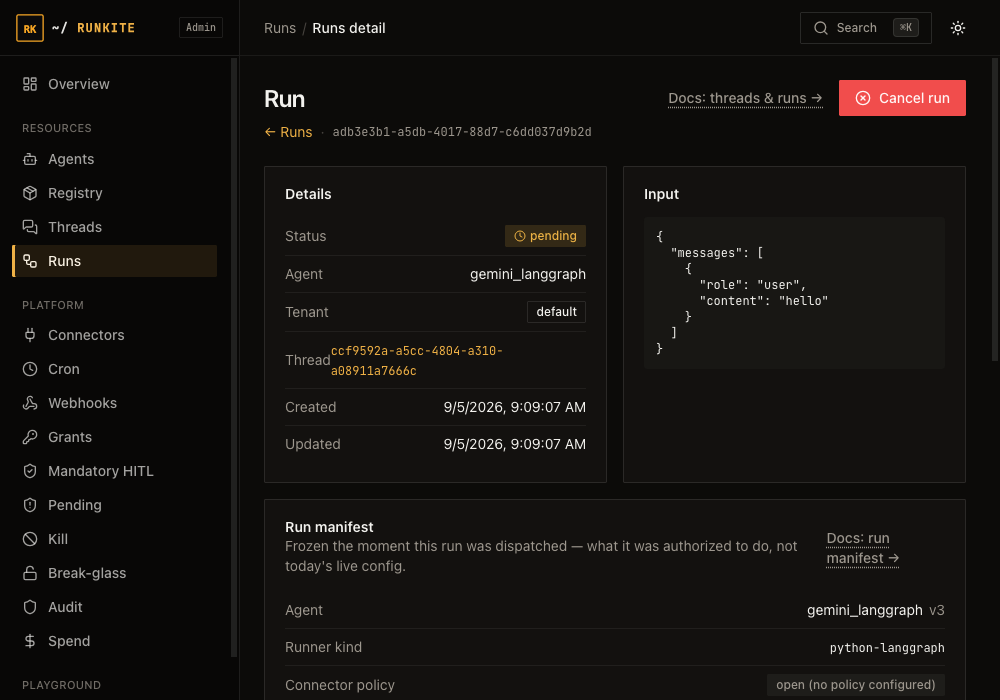
What to expect
- Automatic, no config. Every run gets one in metadata, there's nothing to turn on, and nothing changes about how you write an agent. LLM cache hits get a manifest too (no runner dispatch, so nothing is copied onto a
RunAssignment). - A record, not a gate. This is v1: it captures intent, it does not evaluate sequences of calls or block anything on its own. Reasoning about a sequence of tool calls in flight and denying a suspicious one before it runs is a different, heavier control than a per-run snapshot. Runkite's existing fail-closed grants, mandatory HITL, and break-glass are the enforcement layer; the manifest is what you check afterward to see what any of them were actually working with.
- Lives in existing storage. No new database column or migration, it rides inside the
metadataJSON column every run already has, so it works on every state backend the same way. - API-visible from day one.
GET /admin-api/runs/{id}has always returned it (it's just a key inmetadata); the Admin UI card in this release is what makes it visible without reading raw JSON.
Reference: docs/trust-governance.md · Grants & HITL · Admin UI guide → Threads & Runs · Limitations